CritiCall Practice Test: A Timed Simulator With Multitasking and Audio
This CritiCall® practice test is a desktop simulator, not a question list. Thirteen modules, from audio data entry to map reading, each separately timed, with emergency messages that land on a 15-second clock. Your first full run is free: audio data entry with emergency messages, the multitasking module.
Free sign-up, no card. Needs a computer with a keyboard and headphones or speakers.
Biddle's candidate guide gives you 15 seconds to answer each emergency message. A wrong agency or a late answer earns no credit. At agencies like Newton and Cambridge, one sitting decides the current hiring round. Meet that clock here first.
Start with the free multitasking run
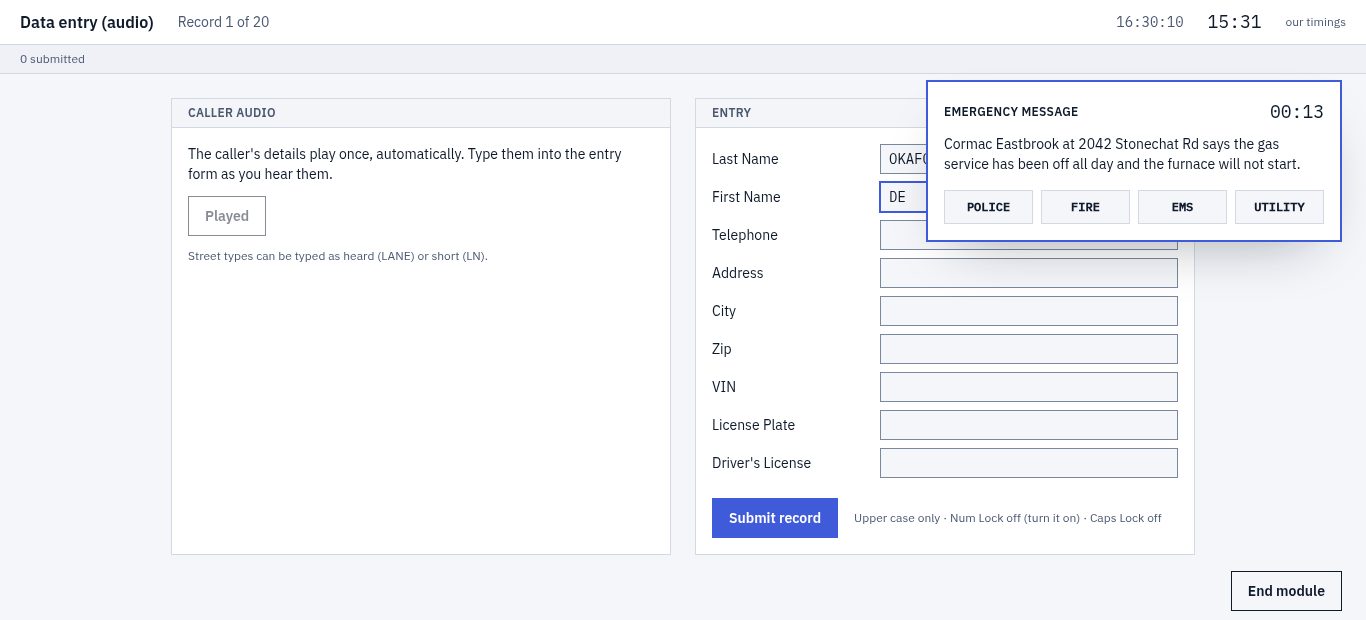
Callers dictate records into your headphones. The first ones come in screen order; later ones arrive in fragments, out of order, the way a hurried caller gives details. You type each value into nine upper-case fields, Last Name to Driver's License, in Biddle's published order. Tab moves forward, Shift+Tab back.
Emergency messages land on top of that. Each goes to Police, Fire, EMS or Utility under the rules shown in the test, within 15 seconds. Habit doesn't count; the rules on screen do.
The timed section runs 16 minutes on our timing, after untimed practice records that don't count. Practice audio can be replayed. Timed audio plays once. When the clock stops, you see net keystrokes per hour, field accuracy and your emergency-message tally, plus the first rows of your record-by-record review.
Practice score from our model — not a CritiCall result. Agencies set their own cut-offs, and most never show candidates a score.
For everything the free run includes, and what stays locked, see the free page.
All 13 modules, each a timed drill
CritiCall contains over 20 tests, Biddle says, and each agency chooses which ones you take. Published batteries run from 3 modules (Scottsdale) to 15 (San Diego, 2011). Pass911 covers 13:
| Module | What you practice |
|---|---|
| Emergency messages | Messages interrupt your data entry. Send each to Police, Fire, EMS or Utility within 15 seconds. |
| Data entry (written) | Copy records into nine upper-case fields in Biddle's published order. |
| Data entry (audio) | Type dictated records: in screen order first, then out of order. |
| Keyboarding | Copy a written passage for five minutes. |
| Call summarization | Hear a call. Type a summary or fill structured fields, then answer multiple-choice questions from your notes and memory. |
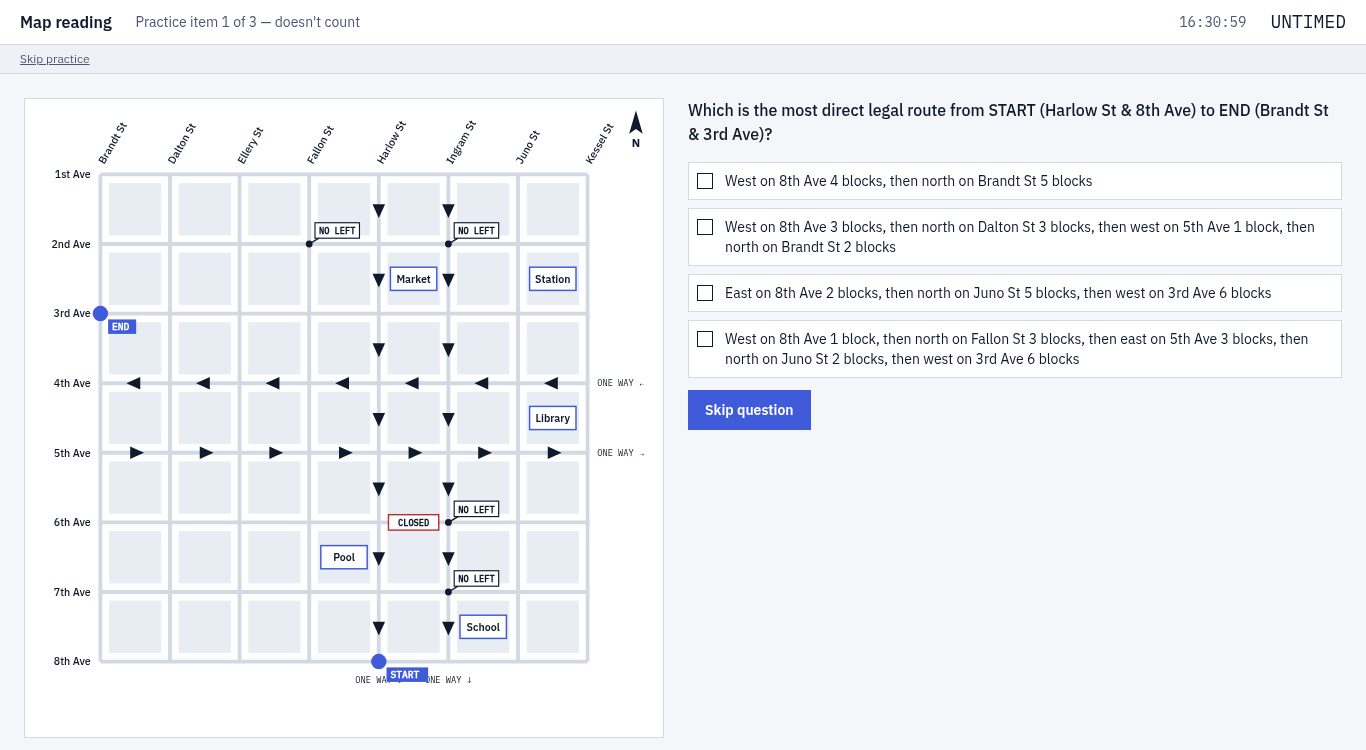
| Map reading | CritiCall map reading practice on fictional street grids: the most direct legal route past one-way streets and turn signs, which way you're facing, and turn-by-turn directions. |
| Memory recall | Word pairs that vanish after a few seconds; seven-digit numbers and codes you hear once and type a moment later. |
| Cross referencing | Alphabetical directories with written and spoken requests; same-or-different pairs. |
| Prioritization | Sort calls into priority levels under our written rule card. |
| Reading comprehension | Short procedure passages from fictional dispatch centers. |
| Spelling | Dictated words, plus sound-alikes chosen in context. |
| Sentence clarity | A list of facts and four sentences. Pick the clearest. |
| Character comparison | Find the exact match among near-identical letter and number strings. |
Biddle publishes no per-module timings or item counts, so ours are set from the session lengths agencies publish. Here's the math. Ten minutes per module, because Newton and Cambridge allow two hours for 11 modules. Sixteen for data entry with emergency messages, because Scottsdale gives its three modules 50 minutes (both rounded down). Five for keyboarding: the length of Winnipeg's typing test, which is separate from CritiCall. Each module opens with untimed practice items that don't count, as Biddle's guide describes. Every rule, record, call, map and passage is ours.
Not covered at launch: position locating, probability, numerical ability, proofreading, vocalization summary and CritiCall 3D's situational-judgment test. We don't coach answers to the 3D personality test. To check your typing speed without an account, use the free 911 dispatcher typing test.
Full batteries for the session your agency sends
On Elite, modules run back to back, each on its own clock, and the total time shows before you start. Pick one of two setups:
- Core battery: written and audio data entry, emergency messages, map reading, memory recall and prioritization.
- Build your own: tick the modules your agency lists, from the 13 we cover. Some agencies publish their lists: Scottsdale names three modules, RCMP Alberta eight, Newton and Cambridge eleven.
How results work
Practice score from our model — not a CritiCall result. Agencies set their own cut-offs, and most never show candidates a score.
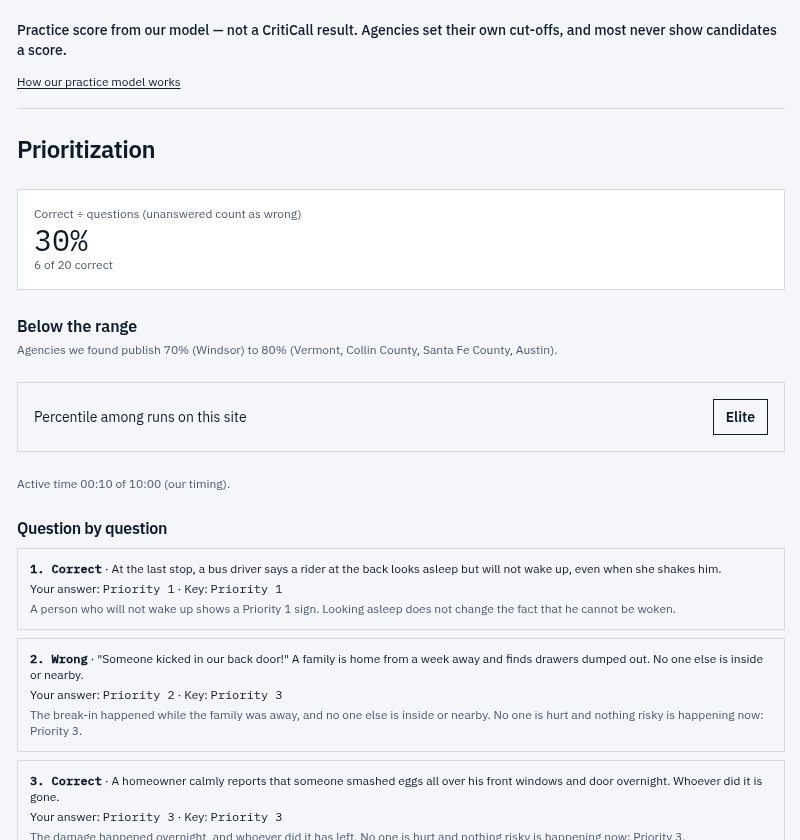
Each module result shows a percentage and a band, with the agencies behind the band:
- Above the bar: 80% and up
- In the range: 70–79%
- Below the range: under 70%
Agencies we found publish 70% (Windsor) to 80% (Vermont, Collin County, Santa Fe County, Austin). Keyboarding shows net words per minute (gross minus 2 per uncorrected error, the rule Winnipeg publishes) against four bands: Clears 40 wpm, Clears 35 wpm, Clears 30 wpm, Below 30 wpm. Data entry shows net keystrokes per hour — our measure. No agency we found publishes a data-entry bar. Typed call summaries are AI-scored against a rubric modeled on the published criteria, with written feedback.
In our practice model, unanswered items count as wrong, because Biddle's guide says skipping is penalized unless a section says otherwise.
Elite adds two overall views, since agencies use both. The weakest-module view fits agencies that require a pass in every module, such as RCMP BC and Colorado State Patrol. The unweighted average fits those that cut on one overall score, such as Pinal, Navajo and Austin. Data entry sits beside the average, not inside it, the way Arizona DPS's posting scores data entry pass/fail apart from the weighted modules. Percentiles compare your run with completed runs of the same module on Pass911 and appear once 30 completed runs exist; runs that used audio replay don't count. The full method: how our scoring model works.
Pricing: Starter or Elite
- Starter, $39: every module as a drill, unlimited, with item-by-item review.
- Elite, $69: everything in Starter, plus full batteries, the two overall views and module percentiles.
- Already on Starter? Upgrade to Elite for $30.
One-time payment, 12 months of access, 7-day money-back guarantee. Prices in USD. See Starter and Elite compared.
Practice score from our model — not a CritiCall result. Agencies set their own cut-offs, and most never show candidates a score.
CritiCall practice test FAQ
Is there a free CritiCall practice test?
Yes. One full run of audio data entry with emergency messages is free with sign-up, no card.
Is this the right 911 dispatcher practice test for me?
If your invitation names CritiCall, yes. Not every 911 hiring test is CritiCall: California also has the POST Entry-Level Dispatcher test, and King County (WA) uses Public Safety Testing's exam. Check the invitation before you practice.
Does Pass911 use CritiCall's own questions?
No. Biddle's applicant FAQ says there is no "practice test" for CritiCall and that it "absolutely cannot give out the demo to the applicants." Every item here is original, built to the format Biddle and the agencies describe.
Which modules will my agency give me?
Your agency picks them from Biddle's set. Check your invitation or the agency's hiring page. If it lists modules, Elite's Build your own battery runs the ones Pass911 covers.
Do I need headphones?
Yes, or speakers, for the audio modules. Biddle's guide says spoken information comes over a headset with adjustable volume. Many agencies send a link and you test at home on your own computer, keyboard and headphones or speakers (RCMP Alberta, Palo Alto, Tarrant County 9-1-1 District). Pass911 runs a headset check before every audio module.
Will my practice score predict my CritiCall result?
No. Practice score from our model — not a CritiCall result. Agencies set their own cut-offs, and most never show candidates a score. Use it to find your weakest module.
How do I pass the CritiCall test?
Know the format before the day, practice under the clock and fix your weakest module first. Our CritiCall test prep plan goes module by module.
Written by the Pass911 team. Test facts checked against Biddle Consulting Group's candidate materials and agency hiring pages on October 23, 2026.