CritiCall Test Prep: A 7-Day Plan, Module by Module
Good CritiCall® test prep starts where the test's publisher starts you. Biddle Consulting Group gives applicants a free candidate guide, and it is blunt about the rest: there is no practice test, and you need no dispatch experience to succeed. So prepare for the format, not for facts. Read Biddle's material, learn what each CritiCall module looks like, then spend a week practicing the modules your agency lists, on a clock, typing and data entry first.
Start with what Biddle gives you
Biddle's position fits in three quotes. There is "no 'practice test' for CritiCall." Biddle "absolutely cannot give out the demo to the applicants." And applicants "need no prior dispatch experience or special dispatcher training to succeed." Take that last one at face value: nothing on CritiCall rewards dispatch knowledge you could cram.
What Biddle publishes is free and worth an hour:
- The candidate guide. Biddle's 2023 Public Safety Communications Pre-Employment Test Preparation Guide covers the screen rules: audio over a headset, upper-case fields, optional practice items at the start of each section, the penalty for skipping, four agency choices for emergency messages with 15 seconds each, and the data-entry field order. Read it first: Biddle's 2023 candidate guide. The "CritiCall test prep guide" PDF on San Diego's website is the 2013 edition of the same Biddle guide, not a San Diego document.
- The map tip. Biddle says its maps have "only very basic elements" and need no map-reading training: know left from right and the compass directions.
None of it puts a clock on a module, plays you a caller, or drops an emergency message into the middle of a record. That's the part left to practice.
How Pass911 practice works
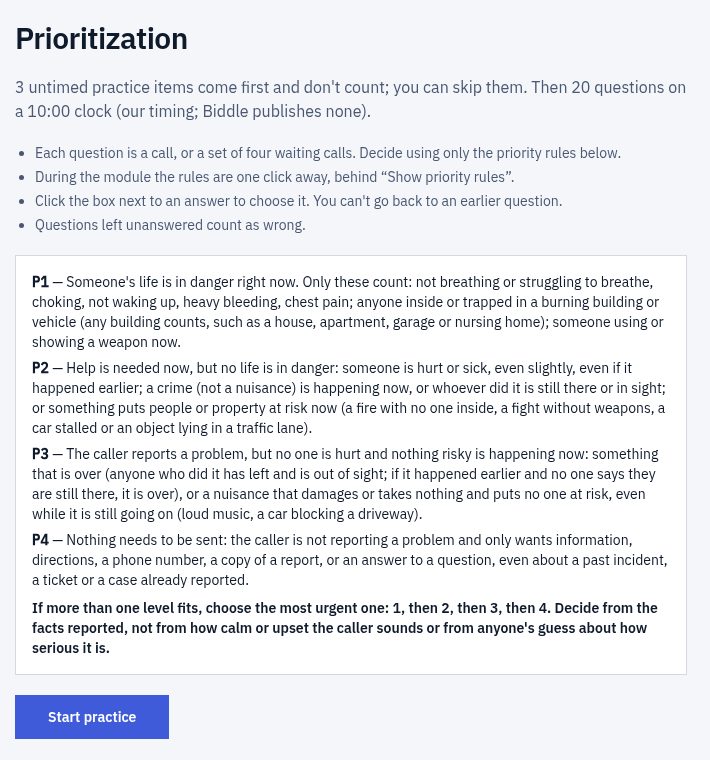
We built each module from Biddle's published descriptions and the agency pages that list it, copying the delivery rules and never the content. Every module opens with optional practice items, untimed and unscored, before the timed section. Unanswered items count as wrong, fields take upper case, and there's no calculator. In timed sections each audio clip plays once: Biddle doesn't say whether CritiCall allows replay, so we chose the stricter setting. Before any dictated record went into our audio data-entry module, it had to survive a transcription check. If speech-to-text couldn't recover every field exactly, we re-recorded it.
The timings are ours. Biddle publishes no per-module timings, so ours are sized from the session lengths agencies publish: 10 minutes per module, 16 for multitask data entry, 5 for keyboarding.
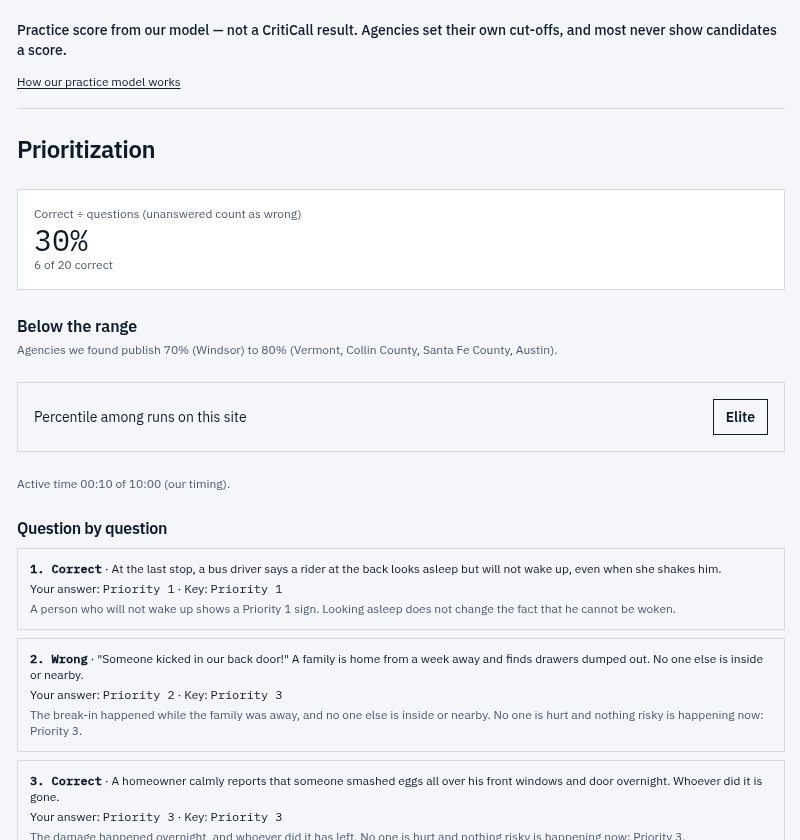
Every results screen opens with the same line: "Practice score from our model — not a CritiCall result. Agencies set their own cut-offs, and most never show candidates a score." Under it come your score, a band against the bars agencies publish, and an item-by-item review. Data entry gets no band, because no agency we found publishes a data-entry bar; you see net keystrokes per hour and field accuracy, our measure. The method is public: our scoring method.
Starter drills one module at a time, and Elite adds batteries: the Core battery, or Build your own from your invitation's list.
Why typing and data entry come first
RCMP British Columbia (Canada) gives the bluntest public warning: "over half of all applicants do not pass the CritiCall Exam due to inability to meet typing requirements." Its bar is 40 wpm with less than 5% errors. Published typing bars run from 30 wpm (Newton, Cambridge) to 40 wpm (Austin dispatchers, Windsor, RCMP), and some agencies, such as Collin County and Winnipeg, test typing separately.
Data entry is typing with rules attached. You copy each record into nine fields, from Last Name to Driver's License, in Biddle's published order and in upper case, moving with Tab and Shift+Tab. Data in the wrong field counts for nothing. In the audio version, a caller dictates the first records in screen order and later ones out of order, so the plate may come before the name, and your job is to put each detail where it belongs.
Three habits to build this week:
- Practice on the keyboard you'll test on. Palo Alto, Newton and Cambridge advise a familiar keyboard with a 10-key number pad over a flat laptop keyboard.
- Turn Num Lock on. Biddle's guide says many test takers find it helpful.
- Get a number. Our free 911 dispatcher typing test needs no sign-up and counts net wpm by the rule Winnipeg publishes for its typing test: two off the gross speed for every uncorrected error.
The 7-day CritiCall prep plan
Plan on about an hour a day. Write down the modules your invitation or the agency's posting lists, and drop any day you don't need. Testing sooner? Do Day 1, your two weakest modules, then Day 7.
Day 1: Baseline. Read Biddle's guide. Then take our free run, audio data entry with emergency messages on top, and the typing test. You'll know your speed and how you handle a message mid-record.
Day 2: Written data entry and emergency messages. Drill data entry with messages switched on, then keyboarding. Watch for the traps Biddle's instructions warn about: answering a message from habit instead of the rules on screen, letting 15 seconds run out while you finish a field, and double-clicking. More on how the emergency messages work.
Day 3: Audio data entry and call summarization. Drill dictated records until fragmented details land in the right fields. Then calls: notes or fields first, questions after. Biddle names the skill as the ability to "filter out non-essential distractions, and summarize important facts," so note what matters, not everything. Typed notes are part of the module; paper is your agency's call, and in-person sessions typically don't allow it. Our typed summaries are AI-scored against a rubric modeled on the published criteria.
Day 4: Map reading and memory recall. Maps reward the most direct route that obeys every one-way and turn sign; the trap is a short route that breaks one. Memory: word pairs that vanish after several moments, then seven-digit numbers and serial codes you hear and type back.
Day 5: Prioritization, cross referencing, character comparison. Rank calls by the rules given, not by gut. Search lists against written and spoken requests. Compare letter-and-number strings where near-identical spellings are the trap.
Day 6: Reading, spelling, sentence clarity. Procedure-style passages, commonly misspelled and sound-alike words (some dictated), and the clearest way to state a set of facts.
Day 7: Full run, then rest. Run your agency's modules back to back on their clocks: one "Build your own" battery on Elite, or the drills in your invitation's order on Starter. Review your weakest module once, then stop. The night before is for sleep and a headset check.
Common questions
How do you pass the CritiCall test?
Clear the rule your agency uses; there's no universal pass mark. Some agencies require a pass in every module (RCMP BC, Colorado State Patrol), some use one overall score (75% at Pinal and Navajo counties, 80% at Austin), and Arizona DPS ranks passers by score. Find your agency's rule in its posting, practice the modules it lists, and get your typing to its bar: 30 to 40 wpm where agencies publish one.
Should I practice for the CritiCall test?
Yes, but practice the format, not facts: Biddle says you need no dispatch experience or special training. What the test punishes is a screen you've never worked, with a 15-second message clock while you type, a caller who gives details out of order, and a skipped item that costs points.
Is there a CritiCall study guide?
Biddle's candidate guide is the closest thing, and it's free. The 2023 edition explains the screen rules, the emergency-message choices and the data-entry fields. It isn't a question bank, and Biddle publishes no practice test.
Is paid CritiCall prep worth it?
Not always. Biddle's guide, our typing test and a few practice maps made in Google Maps cost nothing, and they may be all you need. Paid practice earns its price on what free material can't do: timed modules, dictated audio and emergency messages that land mid-record. Take the free run first. It will tell you which camp you're in faster than any comparison of prep sites could.
One payment, 12 months of access. 7-day money-back guarantee.
Written by the Pass911 team. Test facts checked against Biddle Consulting Group's candidate materials and agency hiring pages on October 23, 2026.