What Is the CritiCall Test? Modules, Length, Scoring and How Hard It Is
The CritiCall® test is a computerized pre-employment test that 911 centers in the US and Canada use to screen dispatcher and call-taker applicants. It's a work sample, not a knowledge exam: at a simulated dispatch screen, you type records, listen to callers, read maps and route emergency messages against a clock. Biddle Consulting Group builds it. Your hiring agency runs it, picking your modules from Biddle's list of over 20 tests, setting its own cut-off and keeping your scores.
Who uses CritiCall, and how to tell it's your test
City and county 911 centers, sheriff's offices, state patrols, and 9-1-1 districts that test for their member agencies. In Canada, the RCMP uses it for 9-1-1 police dispatchers in British Columbia and Alberta and for Telecommunications Operators nationally, as do police services in Windsor and Winnipeg Canadian employers.
Check the name on your invitation: not every 911 hiring test is CritiCall. California agencies can use it instead of the POST dispatcher battery, San Mateo accepts either, and King County, Washington, uses another vendor's exam, so look for the words CritiCall or TestGenius® (Biddle's testing platform) on yours. Agencies pick the setting too: RCMP Alberta tests from home, Newton, Massachusetts, at police headquarters.
How agencies pick your modules
Your agency chooses which of CritiCall's tests you take. Published batteries run from 3 modules (Scottsdale) to 15 (San Diego, 2011); the RCMP uses 8, and Newton and Cambridge use 11.
Names drift. "Decision Making" is the emergency-message task, and "Multitasking" means doing it on top of something else, such as data entry. Prioritization and Character Comparison appear on agency lists though Biddle's current pages don't name them, and typing may be a separate test, as at Collin County and Winnipeg. Find your agency's list and practice exactly that, with a 7-day plan built around it.
The CritiCall modules, one by one
Each module opens with optional practice items that are untimed and don't count. Then its own clock starts, and skipping is penalized unless the instructions say otherwise. Pass911 covers these 13.
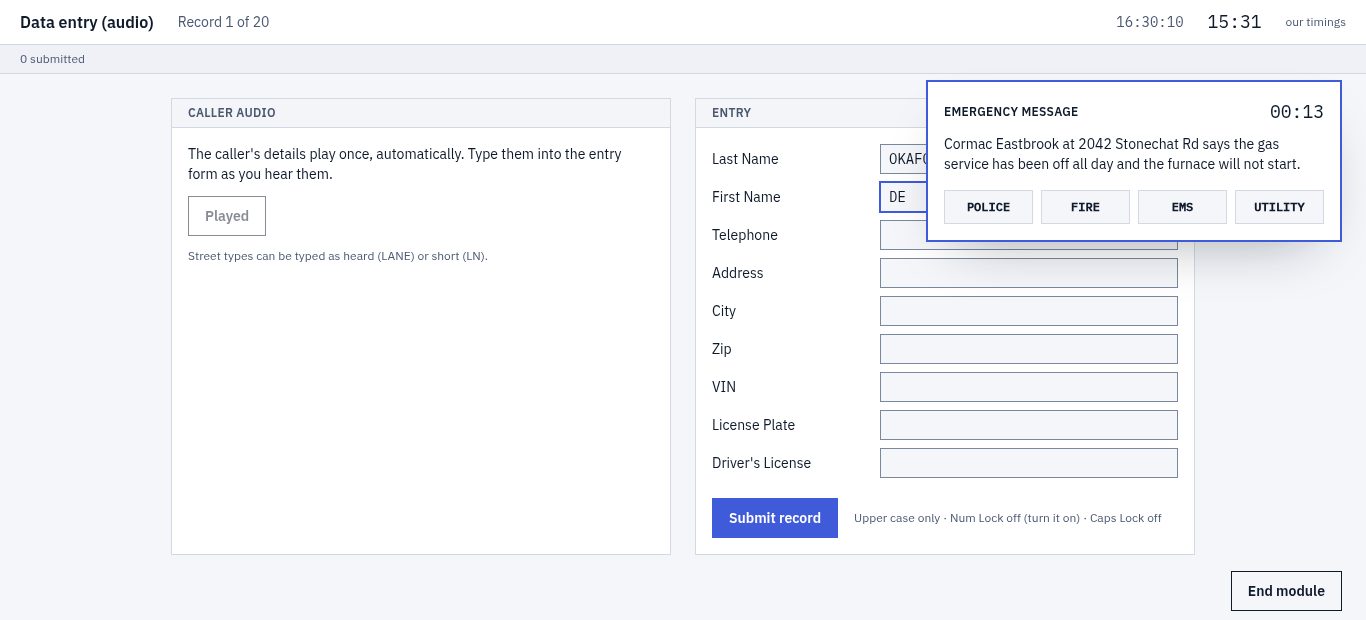
- 01Emergency messages (also "Decision Making", "Multitasking"): messages pop up mid-task; route each to Police, Fire, EMS or Utility, by the rules on screen, within 15 seconds.
- 02Data entry, written (also "Data Entry Multi-Tasking"): copy records into nine upper-case fields, Last Name to Driver's License, while messages interrupt.
- 03Data entry, audio: a caller dictates records, first in screen order, then in fragments.
- 04Keyboarding (also "Typing"): type written paragraphs, scored in words per minute. Try our free dispatcher typing test.
- 05Call summarization (also "note taking"): hear a call, take typed notes or fill fields, answer questions.
- 06Map reading: the most direct route that obeys one-way and turn signs; giving directions.
- 07Memory recall: word pairs that vanish; seven-digit numbers and serial codes, heard, then typed.
- 08Cross referencing: answer written and spoken requests from alphabetical lists; spot whether two entries match.
- 09Prioritization: rank incidents by urgency under the rules you're given.
- 10Reading comprehension: short passages adapted from dispatch-center procedures.
- 11Spelling: commonly misspelled and sound-alike words, some dictated.
- 12Sentence clarity: pick the clearest way to state a set of facts.
- 13Character comparison: compare letter-and-number strings that look alike.
All 13 run in our CritiCall practice test. CritiCall 3D can add situational-judgment and personality tests; we cover the skills modules and never coach personality answers.
How long is the CritiCall test?
Biddle puts the average at one to three hours Biddle's applicant FAQ. Published sessions run from 50 minutes (Scottsdale, three modules) to about two and a half hours (San Diego), with RCMP British Columbia at about 60–90 minutes for 8 modules and Newton and Cambridge at a two-hour maximum for 11. A testing day can outlast the test: Wichita Falls planned about four hours for its whole 2021 testing day. If your invitation gives a time, trust it.
Per-module timings and item counts aren't published (Biddle lists none; agencies give totals), so our practice timings are ours. Newton and Cambridge fit 11 modules into two hours, which gives a standard module 10 minutes; Scottsdale fits three into 50, which gives multitask data entry 16; keyboarding gets 5. On our clock, an 8-module battery like the RCMP's takes 87 minutes.
How CritiCall is scored, and what counts as passing
CritiCall's software scores you; your agency decides what passes. Biddle lets each agency set "a cutoff score custom for your agency" and publishes no universal passing score.
Agencies that publish a bar use 70% (Windsor Police, Ontario) to 80% (Vermont State Police, Collin County, Santa Fe County, Austin); Pinal and Navajo counties in Arizona use an overall 75%. Typing bars run from 30 wpm (Newton, Cambridge) to 40 wpm (Austin dispatchers, Windsor, RCMP). The bars apply in different ways:
- Every module must pass: RCMP BC, Colorado State Patrol.
- One overall score: Pinal, Navajo, Austin.
- Rank order: Arizona DPS ranks everyone who passes; Colorado invites "the top scores" to interview.
- Two tiers: one Arizona DPS posting scores data entry pass/fail and weights the rest.
Scores usually stay with the agency: "Most agencies do not give out test results," says Biddle's help desk. Ours are labeled up front: every results screen opens with "Practice score from our model — not a CritiCall result. Agencies set their own cut-offs, and most never show candidates a score." Bands come only from the published bars above, and the method is public: how our practice scoring works.
Is the CritiCall test hard?
Not the way a knowledge exam is. Biddle says applicants "need no prior dispatch experience or special dispatcher training to succeed," and its maps have "only very basic elements." The difficulty is pace and split attention. Biddle's candidate guide gives you 15 seconds to answer each emergency message, and a wrong agency or a late answer earns no credit. In the multitasking modules, those messages land while you're halfway through a record.
Typing draws the bluntest public warning: RCMP British Columbia (Canada) says "over half of all applicants do not pass the CritiCall Exam due to inability to meet typing requirements." Stakes vary by agency, too. At agencies like Newton and Cambridge, one sitting decides the current hiring round, and Arizona DPS ranks its passers by score.
One full run, emergency messages included.
After the test: results and next steps
Results come from the agency, on its schedule. Pass, and the rest of hiring starts. At agencies such as Tempe, Newton, the Colorado State Patrol and San Diego, that means a panel or oral interview, then background, polygraph, psychological and medical steps, in an order each agency sets. Tested from home? Pinal County invites passers to an in-person validation test.
Common questions
What is the hardest part of the CritiCall test?
Nobody publishes difficulty data, so this is our view: the multitasking modules, where a 15-second message clock runs on top of data entry or a call. Biddle describes the module as requiring "decision making while simultaneously performing other tasks." More on the emergency-message overlay.
How do you know if you passed the CritiCall test?
Your agency tells you. Biddle doesn't hold your scores and most agencies don't release them, so you'll hear whether you advance, made the eligibility list, or didn't pass. Indio emails results within a week; RCMP BC reports pass or fail within four weeks.
How many people fail the CritiCall test?
No Biddle or agency page we read publishes an overall pass or fail rate, so treat any percentage you see as unsourced. The one agency figure we found is about typing: RCMP British Columbia (Canada) says "over half of all applicants do not pass the CritiCall Exam due to inability to meet typing requirements."
What happens if I fail the CritiCall test?
Your agency's rule decides. Palo Alto gives applicants two opportunities to pass. Newton and Cambridge don't reconsider a failed candidate in the current process, though you can apply for future openings. RCMP BC (Canada) allows a retake after a two-week wait, then a three-month wait before reapplying after a second failure. No US agency page we read publishes a waiting period.
One payment, 12 months of access. 7-day money-back guarantee.
Written by the Pass911 team. Test facts checked against Biddle Consulting Group's candidate materials and agency hiring pages on October 23, 2026.